How to efficiently machine shaped parts on CNC mill-turn machines?


With the development of the manufacturing industry, the precision requirements for CNC machining are getting higher and higher.
The multi-axis linkage CNC double-sided milling machine is an essential processing equipment; its machining accuracy directly affects the quality and performance of the product.
In the process of milling machine machining, various factors, such as the nature of the material, tool wear, and milling machine vibration, can influence the generation of machining errors.
Studying effective error control methods for milling machines helps enhance the machining accuracy of multi-axis linkage CNC double-sided milling machines.
These methods improve both machining efficiency and product quality.
As a result, they meet the manufacturing industry’s growing demand for high-precision products.
For this reason, researchers designed a CNC machine tool error compensation method based on the geometric error characteristics discussed in the literature “Research on CNC Machine Tool Error Compensation under the Perspective of Geometric Error Dynamic Characteristics.”.
Based on the construction details of CNC machine tools, this study explores the dynamic behavioral characteristics of geometric error.
It adopts the method of a low-order body array to construct a geometric error model, which analyzes the positional deviation of adjacent low-order bodies in various axial directions and subsequently calculates the error coefficient.
Based on the dynamic fluctuation of the error coefficient, the system flexibly implements the corresponding compensation control.
The literature “Multi-axis CNC machine tool machining contour error control method based on interpolation algorithm” proposes a machining contour error control method based on an interpolation algorithm.
After establishing the tool machining contour error model, the system calculates the difference between the tool’s actual position and its position at the previous moment.
It then uses this difference to determine the contour error components in each coordinate axis direction. By combining these components, it identifies the overall contour error.
Next, the engineers design a controller using the interpolation algorithm.
This controller compares and corrects the detected contour error using preset scaling parameters.
Based on the above analysis, this study designs a new error control method for the machining of a multi-axis linked CNC double-sided milling machine.
Before controlling the machining error, this study first collects real-time state information of the milling cutter during the machining process.
It does so by monitoring and analyzing parameters such as rotational speed, milling force, and vibration on a multi-axis linkage CNC double-sided milling machine.
This information is crucial for subsequent error modeling and error control.
This step provides insight into the real-time state of the milling cutter during machining.
It helps detect potential problems early and allows timely adjustments, laying a solid foundation for controlling machining errors in the following stages.
This study uses sensors (e.g., force sensors, vibration sensors, etc.) to monitor various state parameters of the milling cutter during the machining process.
The data collected includes milling force, vibration signals, and other relevant parameters. Because of space limitations, this study analyzes only the milling force.
Milling force serves as a key indicator that reflects the machining state and closely relates to the condition of the milling cutter.
In the actual machining process, the contact angle of each tooth will change over time, which makes the calculation process quite complicated.
In the multi-axis linkage CNC double-sided milling machine milling process, the milling cutter force situation is more complex.
When a milling cutter is cutting material on a CNC machine tool, it is subjected to forces from three directions, similar to the resistance you feel from different directions when sawing wood with a hand saw.
Tangential force Ft: This is the force that pushes the milling cutter forward, equivalent to the force you apply when pushing a hand saw.
Radial force Fr: This is the force pushing the milling cutter from the side, similar to someone pushing your saw from the side.
Axial force Fa: This is the force in the vertical direction, similar to someone pressing down on the saw from above.
The calculation of these three forces is related to the following factors:
The formulas for these forces are as follows:
Ft =Ktc hD b,
Fr =Krc hD b,
Fa =Kac hD b. (1)
Where: Ktc is the tangential milling force coefficient; Krc is the radial milling force coefficient; Kac is the axial milling force coefficient; hD is the thickness of the milling layer; b is the milling width.
In more complex machines, the tool may be tilted at an angle (like you’re not holding the saw straight, but sawing the wood crooked).
At this point, the forces in the three directions will mix together and manifest themselves in the X, Y, and Z directions, becoming:
Fx = Ftcosα – Frsinαsinβ + Fasinαcos β,
Fy = Ftsinα + Frcosαsinβ – Fa cosαcos β,
Fz = Frcosβ + Fasin β. (2)
These three forces can be calculated using a mathematical formula (formula (2) in your diagram above).
In short, the original three directions of force are recalculated into a new direction according to the angle at which the tool is tilted.
That’s what these formulas 3 in the diagram mean:
Just as you may push lightly and heavily when sawing a log, the force of a milling cutter is not always the same when cutting.
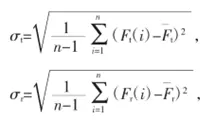

We can use a mathematical tool, the standard deviation, to represent this “fluctuation in force”.
As an example:
The three graphs you provided, is to express this meaning, the standard deviation to reflect the milling cutter force “stability”.
In addition to force, the tool also vibrates when it cuts through material (just like a saw blade shakes when sawing wood).
By attaching an acceleration sensor to the tool (like attaching a “wobble monitor” to the saw), data on the vibrations can be collected.
This data also indicates whether the tool is working smoothly or not.
To summarize:
This system works by doing three things to see how well the milling cutter is working:
This data can help engineers determine: Is the cutter working properly? Is it out of range? This can be adjusted in time to reduce the error of product machining.
This study uses the least squares method to build a multi-axis linkage CNC double-sided milling machine machining error model.
For a multi-axis linkage CNC double-sided milling machine, there is a complex relative position and attitude relationship between the components of the milling machine.
To accurately represent this relationship, we apply the chi-square coordinate transformation.
By performing the chi-square coordinate transformation, we quantitatively represent the geometric error of each component, including errors caused by the number of axes, machine layout, motion characteristics of each axis, and error sources.
Movement is the fundamental method of chi-square coordinate transformation in milling machine machining.
In the milling machine’s three-dimensional coordinate system, we use coordinate transformation to represent positional changes of the parts to be machined, decomposing any movement into vector movements within the corresponding coordinate system..
The principle of chi-square coordinate transformation for milling machine machining is shown in Figure 1.
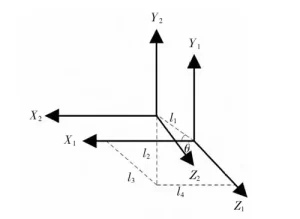
In Fig. 2, l1 is the distance between the coordinate origin before and after the transformation; l2, l3, l4 are the chi-square coordinate moving distance in different directions and their values are not zero at the same time; θ is the angle between the coordinate axes, then the amount of chi-square coordinate transformation of the milling machine machining under the least-squares method is:

Where: vector V is the moving vector of the machining error of the milling machine; κ is the chi-square labeling term of the geometric error parameter; μ is the least squares coefficient.
On this basis, we assume the following:
ψ is the layout parameter of the three-dimensional coordinate system of the milling machine.
N is the number of axes of the milling machine.
c represents the axes motion characteristics.
υ is the relative position solution coefficient of the parts to be machined.
S is the unit area passed by the chi-square coordinate transformation.
e is the comprehensive calibration value of the geometric machining error.
Based on these definitions, we establish the machining error model of a multi-axis linkage CNC double-sided milling machine as follows:

After completing the modeling of the machining error of the milling machine, this study introduces the PLC technology to adjust the zero position of the milling machine intelligently, and then carry out the error compensation.
After using equation (5) to obtain the machining error E, we map the value to the milling machine coordinate system.
Then, based on the current position of the milling machine and the milling path, we calculate the adjustment amount of the zero point position as follows:
a = X- g + E. (6)
Where: a is the adjustment amount of the zero position; X is the current position of the milling machine on the horizontal axis; g is the reference point of the milling machine.
In the PLC program, set the new zero point as the reference point of the milling machine and update the coordinate system of the milling machine. According to the calculation result of formula (6), the milling machine control center sends the adjustment command.
After setting the zero point position, the operator performs further tightening and calibration to guarantee the milling machine’s accuracy and smooth operation.
They then initiate a test program to accurately measure the size and shape of the part to be machined and compare this data in detail with the design criteria.
If there is a deviation, it is necessary to return to the zero position and re-execute the adjustment procedure.
After adjusting the zero position, the system carries out machining error control for the multi-axis linkage CNC double-sided milling machine.
By finely adjusting the milling cutter position, the system cancels out residual or dynamic errors to ensure the milled part meets the expected size and shape accuracy.
If a small deviation is detected between the machined part and the expected size, it is compensated for by micro-adjustment of the milling cutter feed. The formula for calculating the micro feed is as follows:
m = ηa + λ. (7)
Where: m is the micro feed amount of the machining milling machine tool holder; η is the compensation coefficient, which is used to adjust the sensitivity of the feed amount; λ is the existence of a slight deviation between the machined part and the expected size.
According to the calculated micro feed amount m, the position of the milling cutter is finely controlled.
Since the double-sided milling machine is characterized by double-sided machining, it is necessary to ensure synchronous adjustment of the zero position of the two milling cutters when adjusting the zero position to ensure the accuracy of double-sided machining.
When calculating the micro feed amount, it is necessary to calculate the micro feed amount of the two milling cutters separately and carry out synchronized control to ensure that the error of double-sided machining can be effectively compensated.
To verify the feasibility of the multi-axis linkage CNC double-sided milling machine’s machining error control method, the following experiments are designed.
In the experiment, the technical parameters of milling processing are shown in Table 1.
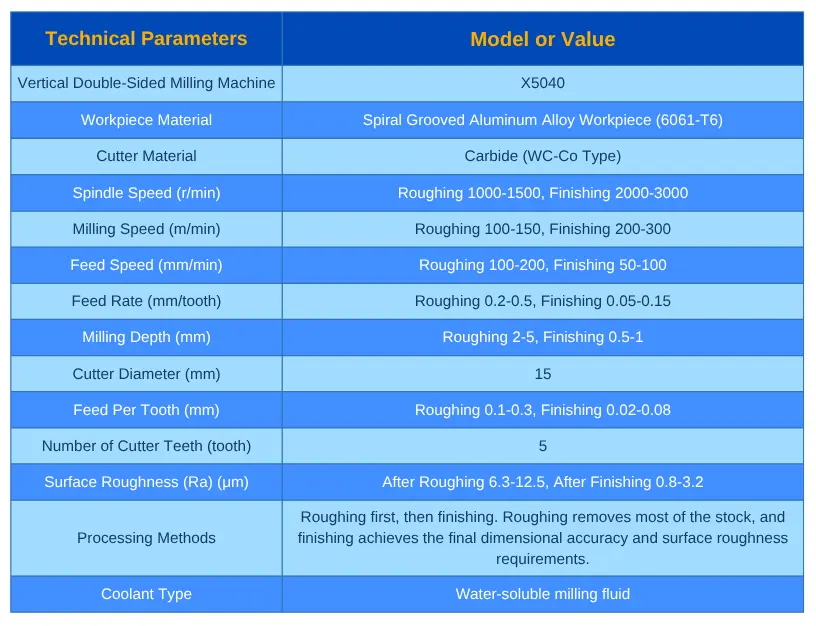
The machining process first roughs, then finishes, roughing to remove most of the allowance, finishing to achieve the final dimensional accuracy and surface roughness requirements.
The coolant type is water-soluble milling fluid. Experiments were conducted using a multi-axis linkage CNC double-sided milling machine, as shown in Figure 2.
Take the milling process of spiral groove aluminum alloy workpiece as an example, the number of spiral grooves of the workpiece is 3, the width of the spiral groove is 3mm, the depth of the spiral groove is 2mm, the spiral groove helix angle is 30 °, the diameter of the workpiece is 50mm, and the length of the workpiece is 100mm.
Although the current intelligent compensation system can predict and adjust some of the deformation, the circumferential position of the spiral groove on the workpiece (i.e., the position around the workpiece axis) is still in error due to the limitations of the model accuracy.
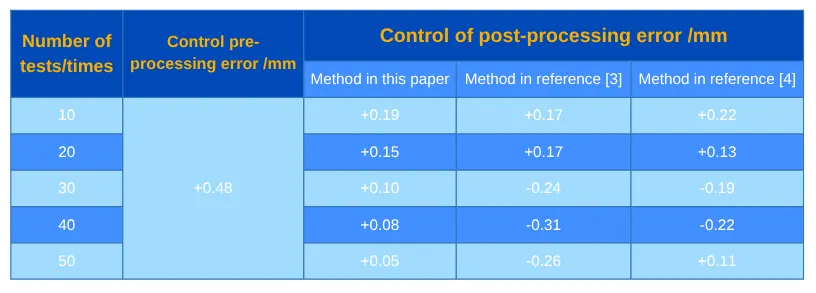
The existing error amounted to +0.48 mm, with an allowable error of ±0.2 mm.

In the experiment, the literature method and the control method are used to complete the comparison experiment with the method of this paper.
Based on the above experimental preparation, this study tests the machining error of thin-walled parts before and after optimization.
It also performs a milling simulation of the workpiece in a MATLAB environment to evaluate the circumferential positional error of the workpiece’s helical groove after applying different methods. Table 2 shows the test results.
Analyzing Table 2, it can be seen that the error of the circumferential position of the workpiece spiral groove is +0.48mm without any error control.
After applying the method of this paper, the error gradually decreases with the increase in the number of tests.
From the initial +0.19 mm to the final 0.05 mm, in terms of error value, are within the allowable error ± 0.2 mm, indicating that the method of this paper can effectively control the machining error and make it meet the accuracy requirements.
The literature method can reduce the error under some test times, but the fluctuation of the error is significant and exists beyond the allowable error range.
After applying the literature method, the error of some test times exceeds the allowable error range, such as the 30th and 40th tests.
In summary, this paper’s method effectively controls machining errors; all test results stay within the allowable error range, and the errors gradually decrease as the number of tests increases.
In the context of the growing demand for high-precision products in the manufacturing industry, the machining accuracy of multi-axis linkage CNC double-sided milling machines has become critical.
This article proposes a new machining error control method. It extracts the machining state characteristics of the milling cutter by monitoring its rotational speed, milling force, and vibration parameters.
Using the least squares method, it builds an error model and combines PLC technology to intelligently adjust the milling machine’s zero position for real-time error compensation.
The experimental results show that the method can effectively control the machining error, meet the accuracy requirements, and significantly improve the machining efficiency and product quality.